OSM Releases
OSM follows a regular cadence of two releases per year, alternating between Long-Term Support (LTS) releases (2 years of support with bug fixes and security patches) and Standard releases (6 months of support).
For a comprehensive overview of OSM functionalities across all releases, see the OSM White Papers and Release Notes on the OSM wiki.
Release TWENTY
Type: LTS | Support: 2 years | Install: OSM Release TWENTY installation guide
OSM Release TWENTY is an LTS release of OSM that marks the 10th anniversary of OSM and the relaunch as ETSI SDG OSM. Produced by the OSM Community, it reflects ten years of innovation, continued improvement and development while meeting the established cadence of two releases per year.
During these ten years and 20 releases, OSM reached major technical milestones: ETSI NFV SOL005 support, Kubernetes clusters and workloads, Network Slicing, a service assurance architecture for monitoring, auto-healing and auto-scaling, Day-1/Day-2 configuration through Execution Environments, the evolution from a VM-based installation to an all-in-one Kubernetes-based installation, a production-ready release management procedure, and, more recently, the GitOps-based declarative framework for infrastructure and application lifecycle management.
OSM Release TWENTY continues the modernization effort started in Release NINETEEN, completes the migration to Python 3.13, broadens infrastructure support with a new VIM connector and enhanced OpenStack networking, streamlines NS/VNF package and instance operations, and migrates the OSM User Guide to a modern, multi-version documentation platform. It includes significant improvements in the following key areas:
- Cloud and Kubernetes infrastructure. OpenStack Cluster API (CAPI) clusters now support Network Security Groups, and OpenStack VM interfaces can use allowed-address-pairs to expose virtual IPs for active/passive HA scenarios. When a VIM has multiple registered Kubernetes clusters, NS instantiation with KDUs can now follow a configurable cluster-selection policy — fixed, round-robin, metric-based, or random — and VIMs with associated Kubernetes clusters are now protected from deletion. OpenNebula was also introduced as a new VIM/Cloud account type, supported in both the imperative and declarative frameworks.
- NS/VNF lifecycle and APIs. NS instances, NS packages, and VNF packages can now be deleted in bulk through a new API and matching osmclient commands. Day-1/Day-2 actions at the NS level are now supported for Helm-based Execution Environments, extending config primitives beyond Juju charms to Helm-backed NS configurations. NS descriptors containing only VLDs (connectivity services) with no VNF profiles are now correctly instantiated, and cloud credentials management for CAPI clusters was fixed.
- osmclient and NG-UI usability. NG-UI was upgraded to a stable, actively maintained Angular version and gained new Alerts and App Instances sections. osmclient adds shell autocomplete support for bash and zsh, along with new command and subcommand aliases that improve usability while keeping backwards compatibility.
- LTS and code maintenance. All remaining Python-based modules were upgraded to Python 3.13, and the IM module was simplified with pre-generated pyangbind bindings, removing its install-time code-generation dependency. Continuing the Release NINETEEN initiative, osm-krm-functions, osm-nushell-krm-functions, keystone, prometheus-sidecar, sw-catalog, and webhook-translator were extracted into self-contained independent repositories.
- Documentation modernization. The OSM User Guide was migrated from Sphinx to MkDocs with the Material theme, adding multi-version navigation across all supported releases (v10 to latest), and restructured following the Diataxis framework, with a new EOL notice banner and shared OSM topbar. Its content was expanded to cover GitOps installation, Prometheus-based VIM metrics, recorded demo videos, VNF onboarding guidelines, and the OSM Developer Guide, and now fully documents osmclient commands. The SOL003/SOL005 OpenAPI specifications were also reviewed and corrected for consistency with NBI.
Release NINETEEN
Type: Standard | Support: 6 months | Install: OSM Release NINETEEN installation guide
Release NINETEEN brings a modernization of codebase and dependencies and makes future development easier for the Community.
OSM Release NINETEEN includes the following improvements:
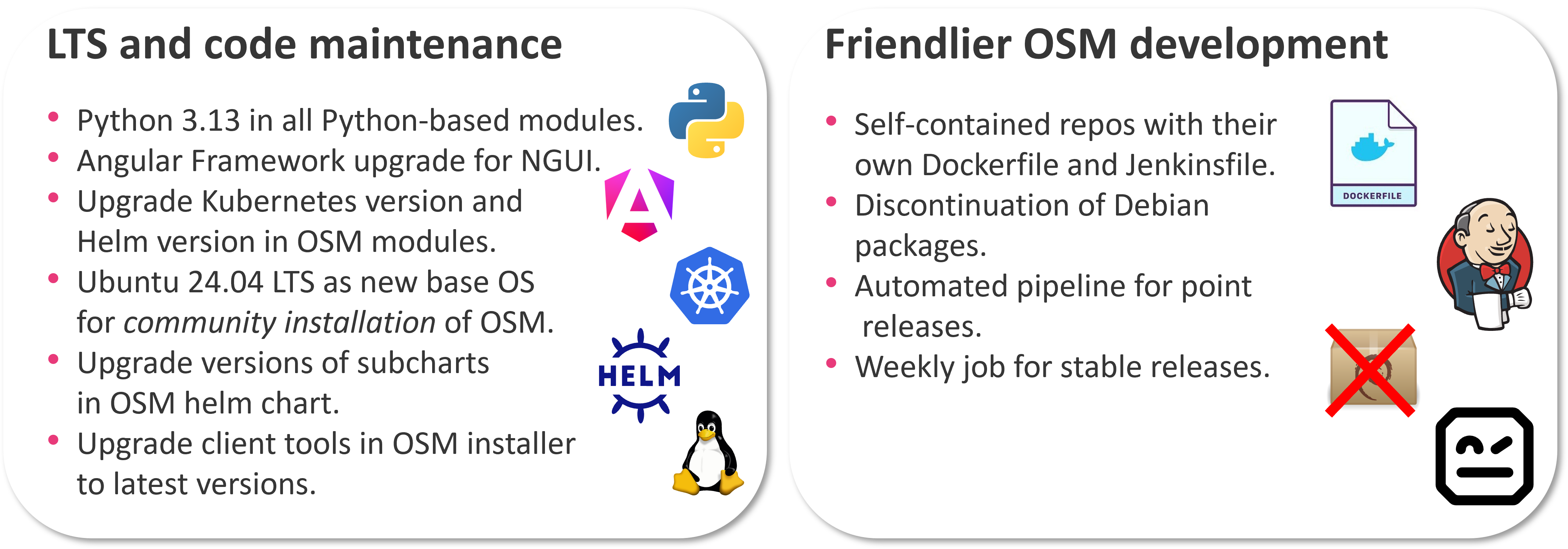
- LTS and code maintenance:
- Python 3.13 in all Python-based modules. All Python-based modules are updated to Python 3.13, ensuring continued upstream support.
- Angular Framework upgrade for NG-UI. The GUI module has been upgraded to the latest Angular framework.
- Upgrade of Kubernetes and Helm versions. All OSM modules have been updated to support the latest versions of Kubernetes and Helm and their associated libraries.
- Ubuntu 24.04 LTS as the new base OS. The OSM installer has been updated to work with Ubuntu 24.04 LTS and upgraded versions of subcharts and client tools.
- Friendlier OSM development:
- Self-contained repos. Every OSM repo is now fully independent: Debian package generation has been discontinued, dependencies on common modules have been simplified, and each module ships a single Dockerfile and Jenkinsfile.
- New pipelines to automate project management tasks. Automated pipelines now handle point releases and weekly monitoring of stable releases.
Release EIGHTEEN
Type: LTS | Support: 2 years | Install: OSM Release EIGHTEEN installation guide
Release EIGHTEEN builds upon the architectural evolution of previous releases, further consolidating OSM as a cloud-native orchestrator for infrastructure, platforms, and services. It introduces significant advancements in declarative operations, cluster management, and modular installation.
OSM Release EIGHTEEN includes the following highlights:
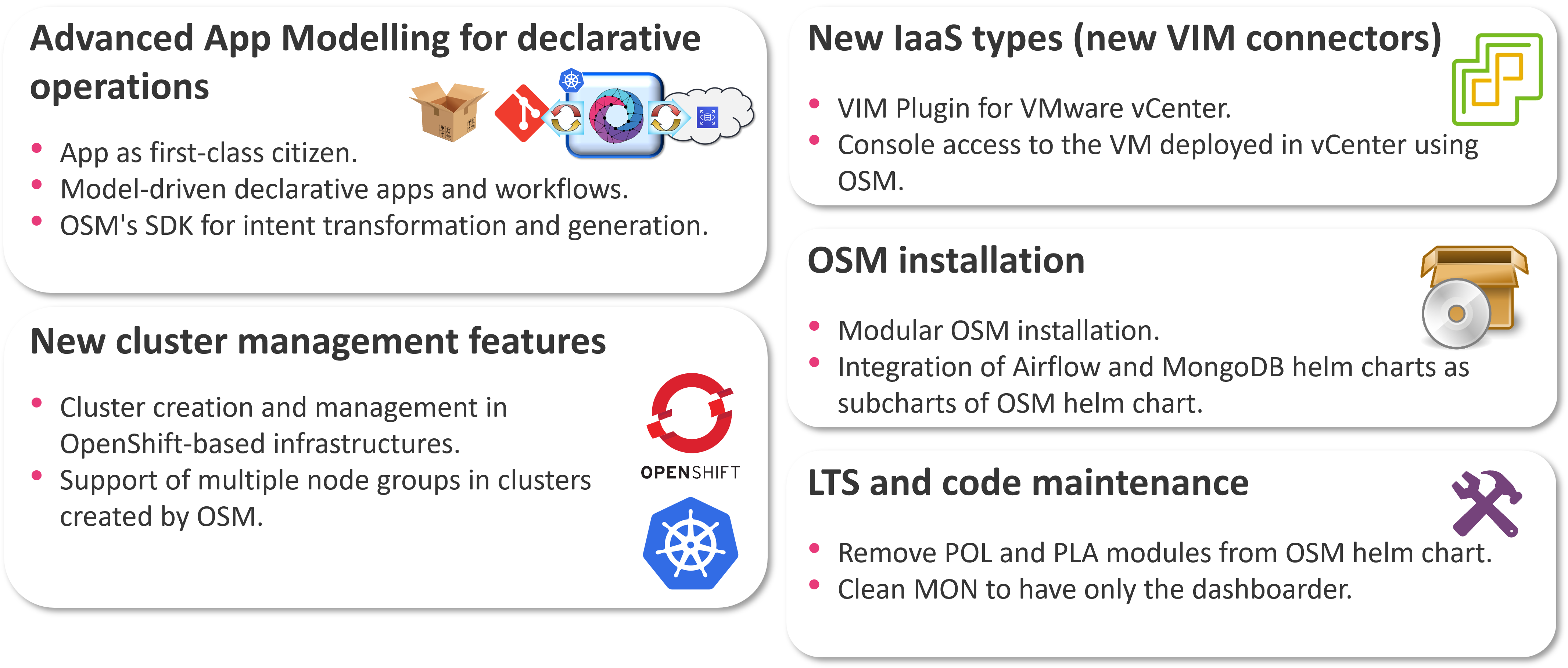
- Advanced Application Modelling. Applications as first-class entities using declarative, intent-driven models: structured OKA blueprints for components, traits, and transformations; unified Argo Workflow for all App operations; support for multiple optional KSUs per App; and a new SDK for high-level, type-safe transformation scripting.
- Enhanced Cluster Management. OpenShift cluster support and multi-node group management for AWS clusters.
- New VIM Connectors. A VMware vCenter plugin with VM console access, expanding IaaS support.
- Modular Installation. Airflow and MongoDB are integrated into a unified Helm chart, creating a single all-in-one OSM Helm chart that includes all components.
- Service Assurance Framework Updates. Legacy POL and PLA modules have been removed, and the MON module has been simplified to retain only the dashboarder.
Release SEVENTEEN
Type: Standard | Support: 6 months | Install: OSM Release SEVENTEEN installation guide
Release SEVENTEEN consolidates the new architecture and scope introduced in Release SIXTEEN, positioning OSM as a generalized cloud-native orchestrator for infrastructure, platforms, and services. The full cloud-native management of Kubernetes clusters introduced for public clouds has been extended to private clouds based on OpenStack.
OSM Release SEVENTEEN includes significant improvements in the following key areas:
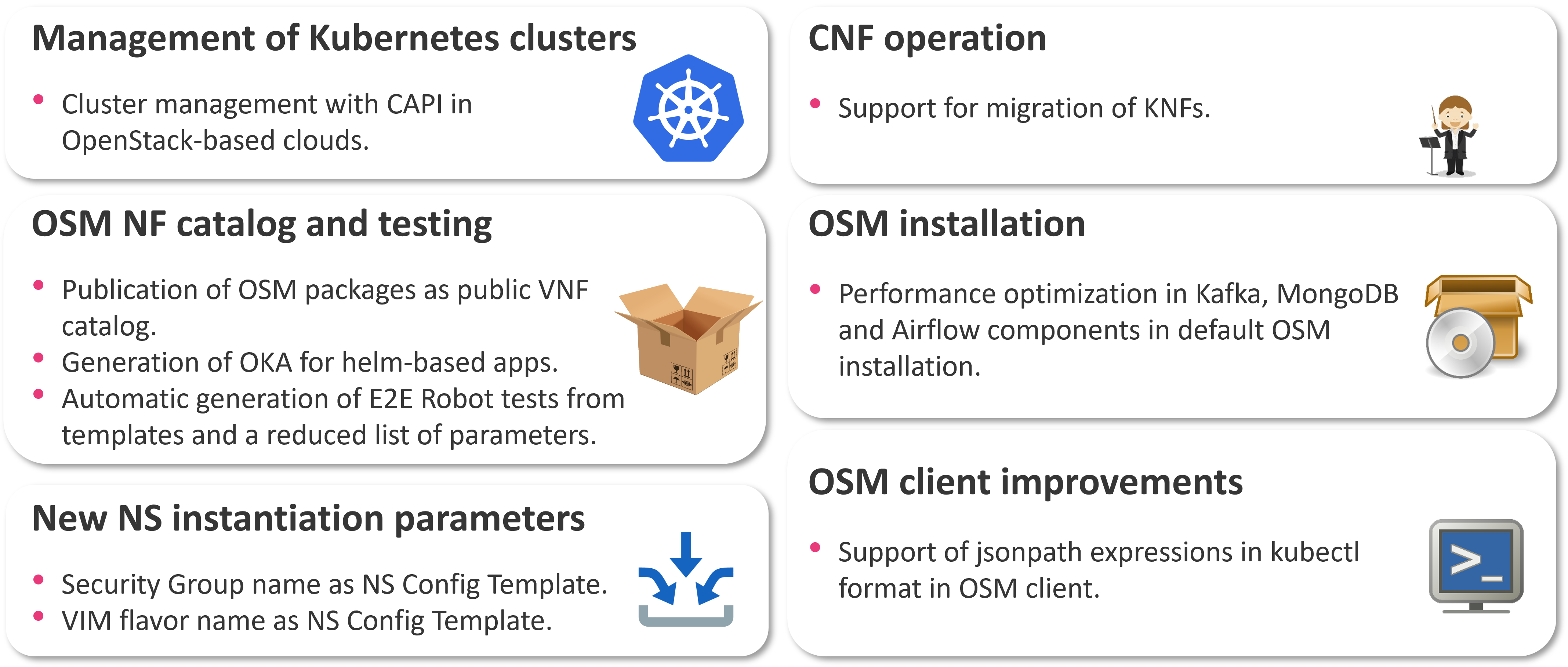
- Management of Kubernetes clusters. Full lifecycle management of Kubernetes clusters on OpenStack-based private clouds using Cluster API.
- OSM NF catalogue and testing. Foundation of an OSM catalogue of NF and NS packages; new tools to simplify the creation of OKA blueprints; automatic generation of E2E Robot tests from NF/NS packages.
- Enhanced capabilities for Network Services. Ability to specify security groups or VIM flavours per VDU as instantiation parameters.
- Improvements in CNF operation. Support for the relocation of KDUs between Kubernetes nodes within a cluster, enabling edge scenarios.
- OSM installation. Performance optimizations in Kafka, MongoDB, and Airflow components, reducing the footprint of the community installation.
- OSM client improvements. Jsonpath output format support for intent-based operation commands (clusters, profiles, OKA, KSU).
Release SIXTEEN
Type: LTS | Support: 2 years | Install: OSM Release SIXTEEN installation guide
Release SIXTEEN brings a revolution in OSM's functionality, positioning OSM as a generalized cloud-native orchestrator for infrastructure, platforms, and services. Full cloud-native management of Kubernetes clusters in public clouds, together with the applications running on them, is now possible. Every operation is reflected in Git repositories, following the GitOps model.
OSM Release SIXTEEN includes significant improvements in the following key areas:
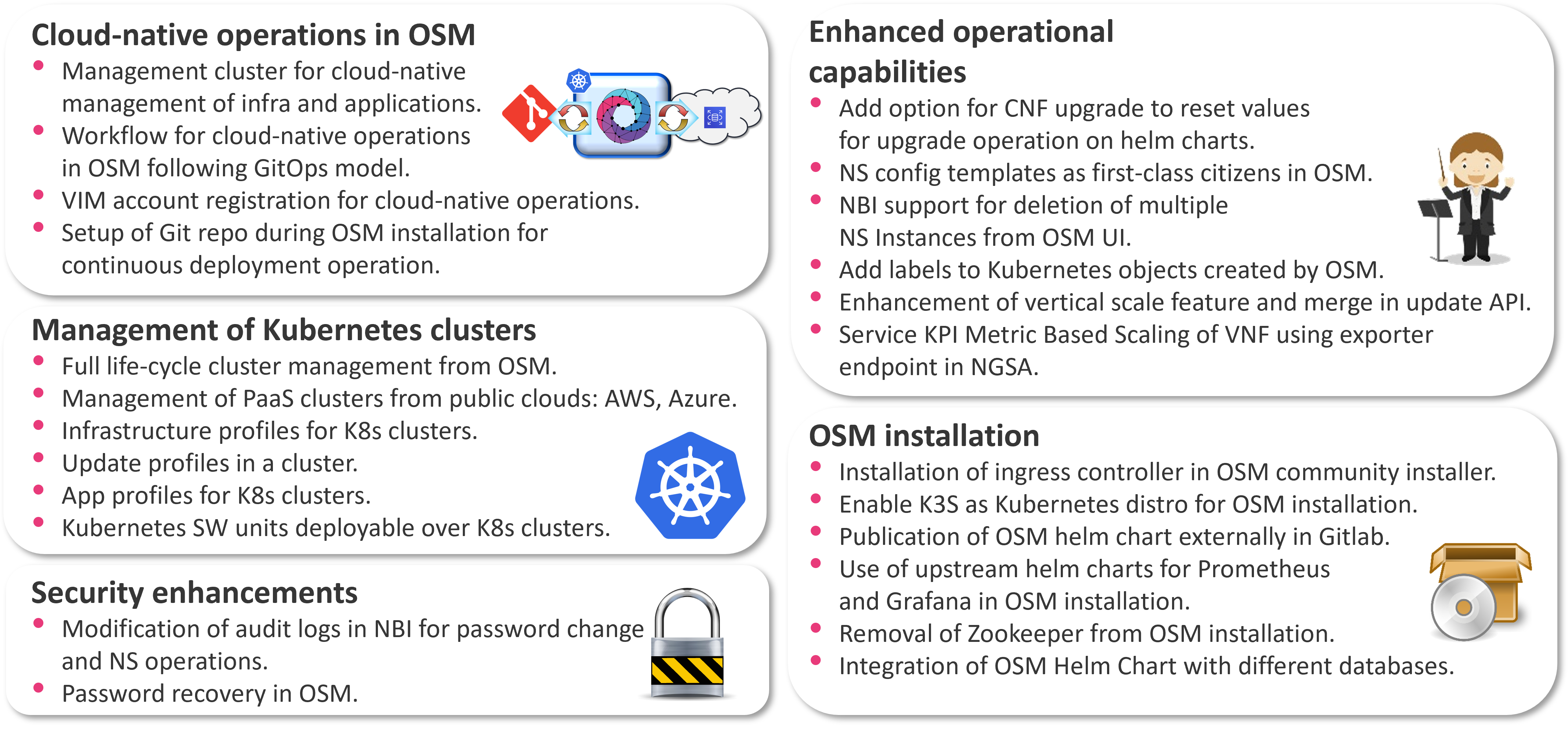
- Cloud-native operations in OSM. Provision of a management cluster for remote cloud-native management; ad-hoc Git repositories automatically created during OSM installation; declarative workflows for all new operations.
- Management of Kubernetes clusters. Full lifecycle management of Kubernetes clusters (create, upgrade, scale, delete) on Azure, AWS, and GCP. Introduction of "profiles" for grouping software units to be deployed to a fleet of clusters.
- Enhanced operational capabilities. NS config templates as first-class citizens; support for deletion of multiple NS instances; new options for upgrading CNFs; improved integration of vertical and KPI-based scaling.
- Security enhancements. Password recovery based on One-Time Password (OTP); improved audit logs for password-related and NS lifecycle operations.
- OSM installation. K3s as default Kubernetes distro; ingress controller for all web services; upstream Helm charts for Prometheus and Grafana; support for pre-existing MongoDB deployments; removal of Zookeeper dependency.
Release FIFTEEN
Type: Standard | Support: 6 months | Install: OSM Release FIFTEEN installation guide
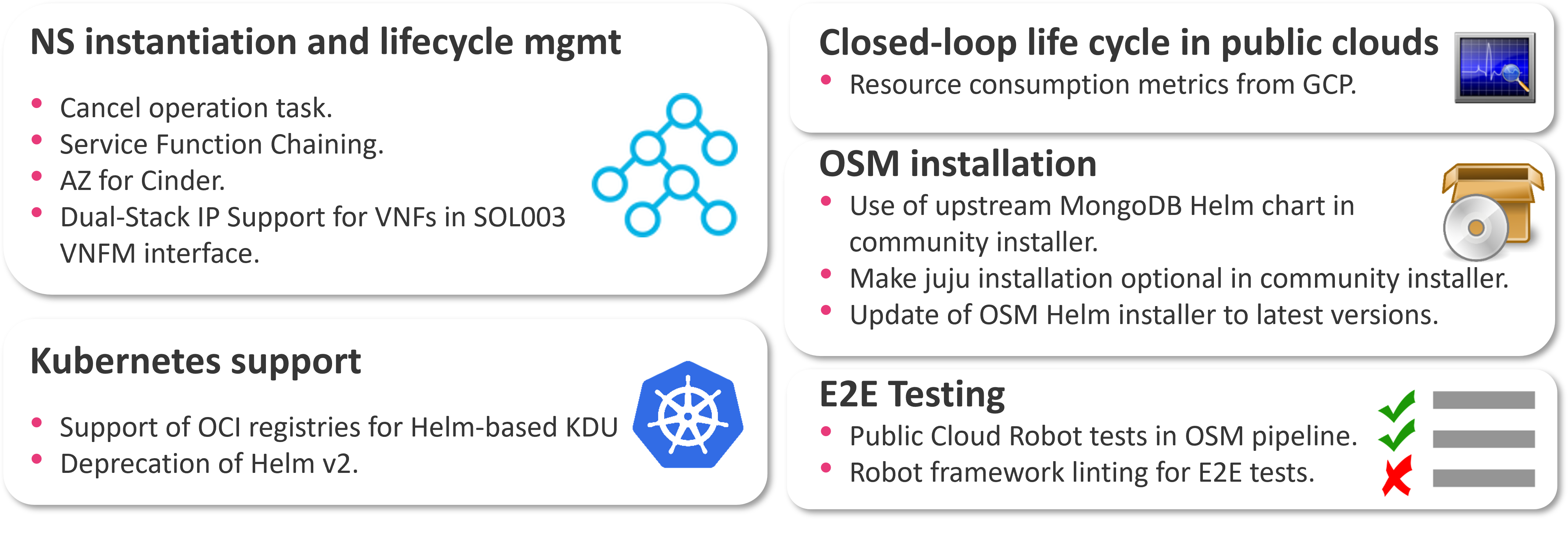
Release FIFTEEN includes significant improvements in many key areas, with a focus on expanding closed-loop capabilities to public clouds and improving Kubernetes support.
OSM Release FIFTEEN includes significant improvements in the following key areas:
- NS instantiation and lifecycle management. Support for Service Function Chaining and Availability Zones for Cinder-based storage in OpenStack; new cancel operation for NS lifecycle.
- Kubernetes support. OCI registry support for Helm-based KDUs; discontinuation of Helm v2 support.
- VNF Management interface. Dual-stack IP support (IPv4 and IPv6) for VNFs launched through the SOL003-based VNFM API.
- Closed-loop lifecycle in public clouds. Resource consumption metrics from Google Cloud added to the SA framework, enabling auto-healing and auto-scaling for VNFs in GCP.
- OSM installation. Upstream Helm charts for Kafka, Zookeeper, MongoDB, and MySQL; Juju made optional in the community installer; updated container images to prevent EOL issues.
- E2E testing. Periodic tests of OSM over Azure Public Cloud added to the pipeline.
Release FOURTEEN
Type: LTS | Support: 2 years | Install: OSM Release FOURTEEN installation guide
Release FOURTEEN offers a new scalable architecture for service assurance based on Apache Airflow and Prometheus, and includes closed loops for auto-scaling and the handling of alerts coming from Network Functions.
OSM Release FOURTEEN brings significant improvements in security, usability, platform management, infrastructure modelling, and lifecycle management:
- Security enhancements. Secured helm-based Execution Environments (EE) with authenticated gRPC; pod admission policies to restrict EE permissions; replacement of Pycrypto with PycryptoDome.
- Usability and platform management. Standard audit logs for all user operations from NBI; retry and password expiry policies for user management.
- Infra modelling and NF lifecycle. Attachment of multiple volumes to VMs; re-use of existing flavors; simultaneous IPv4 and IPv6 support in VM interfaces; instantiation parameters for Juju-based KDUs; new Transport-API WIM connector (TeraFlow SDN).
- OSM installation experience. All OSM components now installed via a Helm chart, enabling simpler upgrades.
- OSM client. Support for different output formats; replacement of Pycurl with the Requests library.
Release FOURTEEN Release Notes
Release THIRTEEN
Type: Standard | Support: 6 months | Install: OSM Release THIRTEEN installation guide
Release THIRTEEN introduces a new scalable architecture for service assurance and closed-loop operations leveraging cloud-native Apache Airflow and Prometheus, prepared to cover the most demanding service assurance scenarios such as auto-healing and auto-scaling in large clouds and multiple edge sites.
OSM Release THIRTEEN includes significant improvements in the following key areas:
- Service Assurance. New scalable SA architecture based on Apache Airflow and Prometheus; new workflows for getting the state of NFs, NSs, and VIMs.
- Execution environments. Improved secured communication channel for helm-based EE; capability to upgrade helm-based EE; new Juju application naming convention.
- NS deployment. Persistent volumes for NF in the VIM; CA certificate storage as part of VIM registration; automatic WIM selection for inter-DC networks.
- Internal LCM evolution. Adoption of the Saga-based pattern for workflow management; LCM–RO communication via Kafka.
- OSM installation experience. Auto-detection of web proxy for OSM installation; automatic publication of charms.
- OSM client. Refactored client commands; Prometheus-based telemetry system registration; Windows and Red Hat Linux installation support.
Release THIRTEEN Release Notes
Release TWELVE
Type: LTS | Support: 2 years | Install: OSM Release TWELVE installation guide
Release TWELVE is the second LTS release of ETSI OSM, providing two years of continuous support with bug fixes and security patches. This is one of the most prolific releases of ETSI OSM, including significant improvements in many key areas.
Release ELEVEN
Type: Standard | Support: 6 months | Install: OSM Release ELEVEN installation guide
Release ELEVEN brings a number of improvements over previous releases.
Release TEN
Type: Standard | Support: 6 months | Install: OSM Release TEN installation guide
Release TEN brings a number of improvements over previous releases.